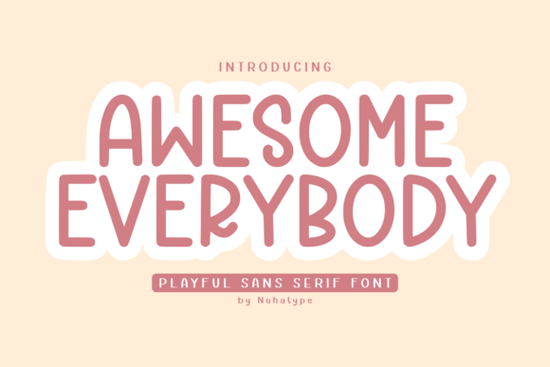
When you need a typeface that feels warm and approachable, Awesome Everybody Font gives you a reliable starting point. It carries a bold weight with softened edges that draws attention without shouting. Designers, crafters, and print-on-demand sellers often choose it to balance professional presentation with a relaxed tone. The open letterforms work well for educational printables, neighborhood posters, and casual brand identities. Small businesses and creative hobbyists apply it to greeting cards, children’s apparel, or social headers where clean typography builds immediate trust.
When does a soft, rounded display style fit best?
Projects aimed at younger audiences or family markets respond well to lettering that removes visual tension. Gentle curves prevent sharp angles from feeling intimidating, which is practical for classroom posters or daycare flyers. Local service providers use the same approach to signal reliability. Print-on-demand sellers can use it for nursery wall art and tote bags, while crafters find it reliable for scrapbook titles and handmade card stock. Because the characters maintain consistent thickness, you avoid uneven weight distribution when printing at home or ordering bulk merchandise.
You will also notice how the spacing interacts with empty areas. Cheerful headers rarely need heavy decoration when the letters already carry energy. Keep backgrounds clean and use high-contrast color combinations so the text stays readable on matte stickers or digital canvases. Always verify contrast ratios before publishing social graphics. Dark charcoal or navy ink works better than pure black when paired with soft pastels. The uniform stroke width cuts cleanly on vinyl plotters and laser machines, reducing material waste.
What tracking adjustments keep readability sharp?
Bold lettering requires careful spacing so the shapes do not collide when scaled down. Increase letter spacing slightly below twenty points to open the negative space inside curved characters. This preserves clarity on small tags or fabric labels. For community banners, tighten tracking just enough to form a unified block while keeping visual rhythm steady.
Line height matters equally. Leave breathing room between lines when formatting instructional guides or recipe cards. Readers follow the flow faster when text blocks are not packed tightly. If a playful headline sits above a dense paragraph, switch to a straightforward sans serif for the body copy to prevent visual competition.
Which complementary display fonts create balanced layouts?
Finding the right pairing depends on how you want the composition to guide readers. If you need structured weight to contrast the main style, reviewing ornate serif families can anchor the layout. Athletic themes benefit from tighter shapes, making traditional collegiate lettering useful for event programs. Narrow columns fit neatly with compressed styles like slender typography. Retro campaigns pair smoothly with hand-drawn retro styles for vintage texture, while editorial spreads rely on structured editorial headers to maintain grid alignment. Test combinations on a single sheet before scaling.
How do you keep warm branding from looking cluttered?
A friendly typeface does not need extra decoration to stand out. Limit your palette to two colors that match your seasonal theme. Use italics only to separate secondary details from the main message. Avoid stacking multiple drop shadows or thick outlines, since those effects blur the clean edges that make this family effective. Export digital templates as vector files so shapes remain crisp across all screens.
Review your files at actual print scale before sending them to production. Zoom out or hold a draft under natural lighting to reveal spacing issues that hide during editing. Minor adjustments at this stage reduce reprints and keep your workflow predictable.
- Adjust tracking at twenty points to keep inner counters open on small tags.
- Pair with a neutral sans serif so the headline remains the focal point.
- Export at 300 DPI for commercial printers and online marketplaces.
- Limit layer effects to flat colors that protect letterform clarity.
- Print a physical proof on the exact stock you plan to use.
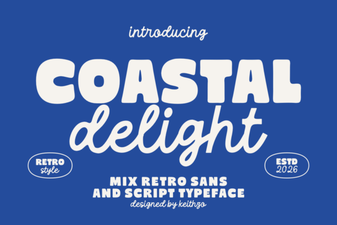 Coastal Delight Font: Design Tips & Download Guide
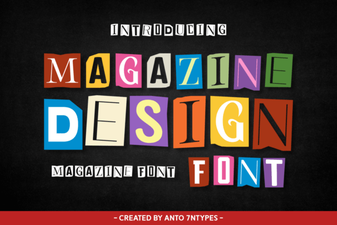 Creative Font Choices for Modern Magazine Design
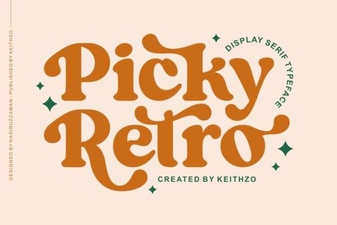 Creative Uses for Picky Retro Fonts
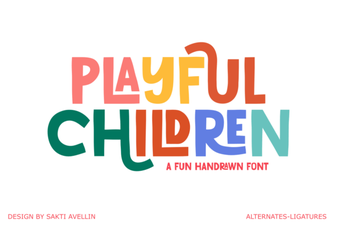 Playful Fonts for Creative Children's Projects
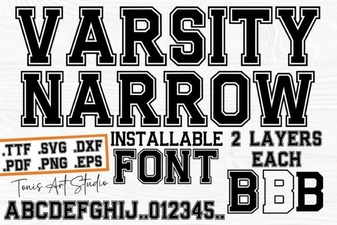 Innovative Design Projects Using Varsity Narrow Font
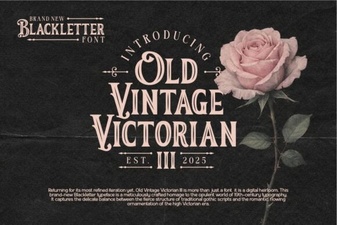 Classic Victorian Font Design Ideas & Uses